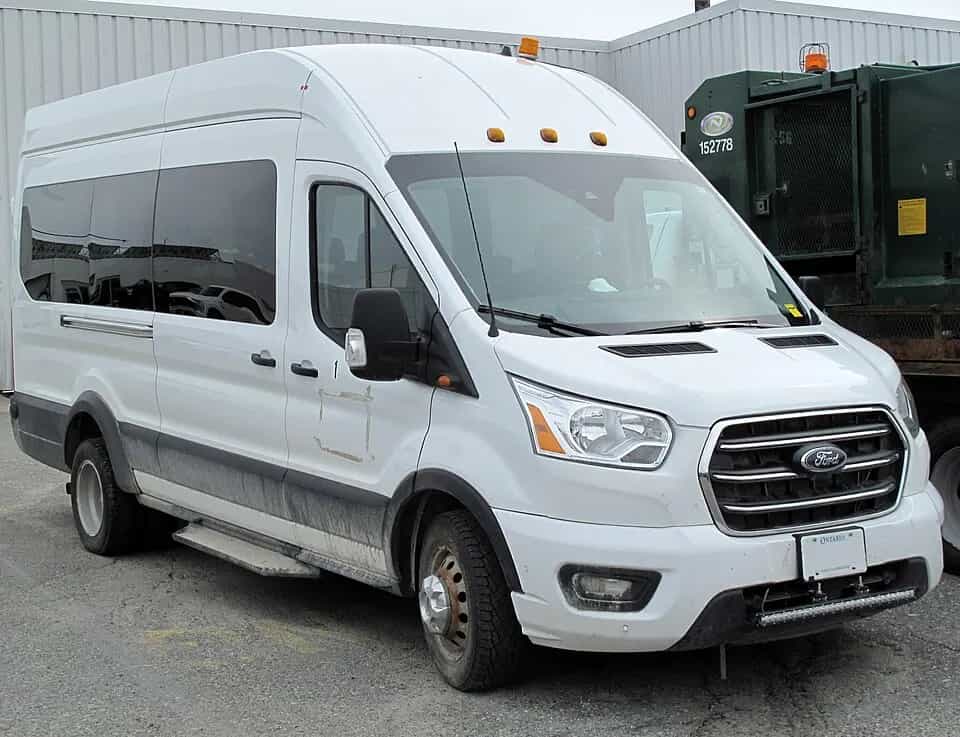
Ford Transit Passenger Van

USCar Trader import service

Import this model from the USA or Canada

Choose a specific vehicle. Where data is available, its detail page shows the import cost calculation. We assess any possible duty benefit with you before purchase.

Important: A 0% EU import-duty rate may be available for a vehicle covered by Regulation (EU) 2026/1455 that has US origin and is imported directly into the EU. CETA may apply to a vehicle with preferential Canadian origin. Whether the requirements are met is assessed for the individual case. Please contact us before purchase; we review the possible duty benefit and provide non-binding support through the process. Import VAT and other costs are assessed separately.

CarHub · Ford

Ford Transit Passenger Van

The US-market Ford Transit Passenger Van is a different beast from the European Transit most people picture: a full-size, body-on-frame-adjacent people mover with big petrol V6 engines, seating for up to fifteen, and three roof heights.

Body style
Typical figure (2015–present US Transit): Full-size passenger van (wagon)
Seating
Typical figure (2015–present US Transit): 8 to 15 passengers
Base engine (2020+)
Typical figure (2015–present US Transit): 3.5L PFDi V6, approx. 275 hp
Optional engine
Typical figure (2015–present US Transit): 3.5L EcoBoost twin-turbo V6, approx. 310 hp
Ford Transit Passenger Van

Model profile

Model history and generations

Model history and generations

Ford brought the global Transit to North America for the 2015 model year, replacing the ancient E-Series (Econoline) wagon. This generation has run continuously since, with a significant 2020 update that added a new 3.5-litre PFDi V6, the option of all-wheel drive, and a switch to a ten-speed automatic. A further refresh brought a larger touchscreen and the SYNC 4 system.

Powertrain and equipment

Engines, drivetrain and trims

Engines and drivetrain

The mainstay engine on 2020-and-later US Transits is the naturally aspirated 3.5-litre PFDi V6 producing around 275 hp, with the twin-turbocharged 3.5-litre EcoBoost V6 as the muscular option at roughly 310 hp and a strong torque figure that makes a fully loaded fifteen-seater feel unstressed.

Which trim makes sense

The Transit Passenger Van comes in a matrix of configurations: three roof heights (low, medium and high — the high roof lets an adult stand inside), and multiple body lengths (regular, long and long-extended).

Vehicle selection

North American market and suitability

Supply on the US market

The assessment depends on the specific vehicle and the circumstances of the transaction. Please contact USCar Trader before purchase; we review any possible duty benefit and provide non-binding support. Import VAT and other costs are considered separately.

Who benefits from importing

The Transit Passenger Van suits large families, shuttle operators, sports clubs, hotels and anyone needing eight-to-fifteen-seat capacity with the durability of a proven American workhorse and the option of a standing-height cabin.

Vehicle data

Technical data by generation and specification

Body and dimensions

Body styleTypical figure (2015–present US Transit): Full-size passenger van (wagon)
SeatingTypical figure (2015–present US Transit): 8 to 15 passengers
Roof heightsTypical figure (2015–present US Transit): Low, medium, high (standing height)
Body lengthsTypical figure (2015–present US Transit): Regular, long, long-extended
Length (long, high roof)Typical figure (2015–present US Transit): up to approx. 6,700 mm

Engine and drivetrain

Base engine (2020+)Typical figure (2015–present US Transit): 3.5L PFDi V6, approx. 275 hp
Optional engineTypical figure (2015–present US Transit): 3.5L EcoBoost twin-turbo V6, approx. 310 hp
Earlier enginesTypical figure (2015–present US Transit): 3.7L V6; 3.2L Power Stroke diesel (2015–2019)
TransmissionTypical figure (2015–present US Transit): 10-speed automatic (6-speed on earlier vans)
DrivetrainTypical figure (2015–present US Transit): RWD standard; AWD optional from 2020
Fuel typeTypical figure (2015–present US Transit): Petrol (diesel on early vans)

Model and other data

Model designationsTypical figure (2015–present US Transit): Transit 150 / 350 / 350 HD
GVWR (350 HD)Typical figure (2015–present US Transit): up to approx. 4,536 kg
OriginThe assessment depends on the specific vehicle and the circumstances of the transaction. Please contact USCar Trader before purchase; we review any possible duty benefit and provide non-binding support. Import VAT and other costs are considered separately.

Values are reproduced verbatim from the existing article table. The documents for the specific vehicle govern.

Pre-purchase review

Model-specific inspection points

Known weak points and maintenance

Ford Transit reliability is generally strong for a hard-working van, but there are known weak points. On the 3.5 EcoBoost, the timing components and the cam-phaser and turbo systems reward strict oil-change intervals; a rattle on cold start can signal phaser wear.

Germany and Europe

Differences, adaptation and registration

US and EU spec compared

The US Transit Passenger Van is petrol-dominated where Europe's is diesel, and it is generally larger in the fifteen-seat configurations.

TUEV, modifications and registration

US-market headlights use the FMVSS/SAE beam pattern, which differs from the ECE pattern required in the EU, so they may need adjustment or replacement with ECE-compliant units for registration.

USCar Trader services

Inspection, purchase processing and escrow

As a buyer based in Germany, you do not have to inspect the vehicle yourself in the United States or Canada. Within the agreed scope, USCar Trader can coordinate document review, a separately commissioned on-site inspection and purchase processing.

  • Vehicle profile and history: The profile can show the VIN, US title status and available history records. No data source guarantees that every earlier event was reported.
  • Optional CARFAX report: Additional reported maintenance or service entries can be included. The report is not a complete service book or proof of every interval.
  • On-site inspection / USCT AutoCheck: USCar Trader can arrange a separately booked vehicle inspection. Agreed visible and accessible areas are documented. Road or functional tests require suitable access and seller approval; the visual review is not a lift inspection or workshop diagnosis.
  • Purchase processing and escrow: After approval, USCar Trader can coordinate seller contact, negotiation, contract and the escrow and import service. Fees, payment route and responsibilities are recorded in advance.
  • Recalls: Open safety recalls can be checked by VIN through the NHTSA recall search; they do not describe overall condition.

Covered inspection points are agreed in advance. An on-site inspection records condition at the appointment and is not a guarantee.

Next step: Before commissioning, USCar Trader and the customer agree which document, history, inspection and transaction checks suit the vehicle and are included in the service. This records what was actually checked.

Import process

Import, customs, costs and delivery

The import process in detail

The assessment depends on the specific vehicle and the circumstances of the transaction. Please contact USCar Trader before purchase; we review any possible duty benefit and provide non-binding support. Import VAT and other costs are considered separately.

Questions and answers

Common questions about importing this model

Is the US Ford Transit different from the European one?

Yes. The US Passenger Van is petrol-led, offered in larger fifteen-seat configurations, and built in Missouri rather than Turkey.

When should USCar Trader be contacted before purchase?

Whether a duty benefit may be available for the specific vehicle is assessed individually. Please contact USCar Trader before purchase; we review the case and provide non-binding support through the process.

Does this vehicle automatically qualify for a 0% import-duty rate?

No, not automatically. A 0% EU import-duty rate may be available for a vehicle covered by Regulation (EU) 2026/1455 that has US origin and is imported directly into the EU. CETA may apply to a vehicle with preferential Canadian origin. Whether the requirements are met is assessed for the individual case. Please contact USCar Trader before purchase; we review the possible duty benefit and provide non-binding support. Import VAT and other costs are assessed separately.

How is import VAT treated when importing a Ford Transit Passenger Van?

Import VAT and other taxes or costs are assessed separately under the applicable rules and the circumstances of the individual case. A blanket answer for every vehicle would not be reliable.

What engines are common?

The 3.5-litre V6 and the 3.5 EcoBoost twin-turbo V6 on 2020-and-later vans; earlier vans offered a 3.7 V6 and a 3.2 diesel.

Do I need a special licence for a 15-seat van?

Possibly. Vans configured for more than eight passenger seats can fall into a higher licence category in Germany, so check before you import.

How long does the import take?

Plan for roughly eight to twelve weeks from purchase to German registration, allowing for the shipping of a large-bodied van.

Is USCar Trader a Ford dealer?

No. We are an independent broker for used US vehicles, with no manufacturer partnership and no dealer margin.

More vehicles